
You can grasp a new field in half an hour, how to quickly establish a cognitive framework using AI?

Original Title: "Sharing a Deep Dive Prompt I've Been Using for 2 Years, Helps You Understand Any Unfamiliar Field in Half an Hour."
Original Author: Digital Life Kazek
A couple of days ago after finishing a conference, then yesterday on the weekend, I was having dinner with a friend. As we were chatting, he suddenly put down his chopsticks, looked at me, and said, "Dude, how come you seem to know a little about everything?"
I said I don't know.
He said, "How come it feels like you can chat about anything, like Harness, like Claude Code, like psychology, like Hitman 2, like Cthulhu Mythos, and yet you still have time to play Pokémon popakia? How many hours do you have in a day, really?"
I was stunned at that moment.
Because to be honest, while talking big is one thing, I really didn't feel like I knew everything. I'm just curious about many things and have a way to quickly familiarize myself with something unfamiliar.
He asked again, "What way?"
I said, "A research framework I developed myself, combined with AI. I can create a research report of one to two thousand words in half an hour, which can help you quickly get started."
He put down his chopsticks again.
Then he said, "Put this thing in writing."
So that's how this article came about today...
I don't know if it's useful to everyone, but it's indeed the methodology I used three years ago when I was still in the financial industry, the methodology used by research companies and the industry. Then AI came along, various types of in-depth research emerged, I slightly iterated on this methodology myself, packaged it into a Prompt used for many AI's in-depth research functions, which can be applied to my study of anything. Honestly, I think this is one of the handiest things I've used in the past two years.
I dare not say how thorough the research produced by this thing is, but it can at least help me quickly establish a fairly complete cognitive framework and then dig deeper within that framework.
I used to call this methodology...
The Horizontal and Vertical Analysis Method.
Let me first explain what this thing is.
Actually, it's very simple, just two axes.
The first axis, vertical. It is to trace back the complete story of something along the timeline, from its birth to the present. How did it come about? Who created it? What did it go through along the way? Why did it suddenly take off at a certain point, or suddenly pivot? Once you untangle this timeline, you can roughly understand the history and causality of something.
The second axis, horizontal. It is to juxtapose it with other things in the same space at the current moment. How is it different from its competitors? Why do users choose it over others? Where does it stand in the entire space? Once you clarify this aspect, you can understand the position and differentiation of something.
Then the most critical step is to cross these two axes.
The vertical tells you how it got to today, the horizontal tells you where it stands today. When these two axes intersect, you can see things that you couldn't see by looking at either axis alone. For example, a certain advantage it has today is actually the result of a seemingly insignificant decision made three years ago that accumulated over time. Or a certain weakness it has today is actually the consequence of a sensible choice made initially that turned into a burden.
Trace depth along the vertical axis, breadth across the horizontal axis, and finally, make your judgment at the intersection.
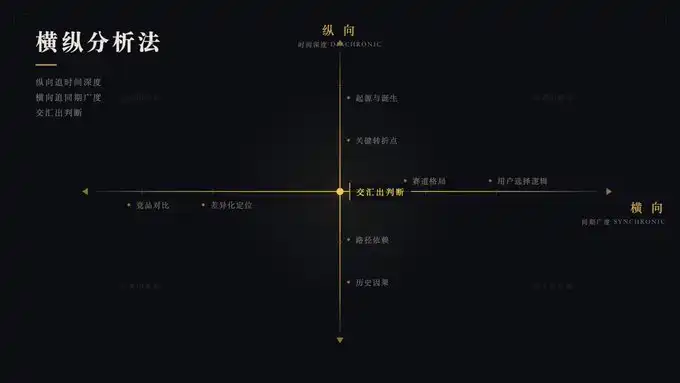
That's all there is to it.
It's also the method I've found most handy to use in the past two years.
This method is actually derived from some classic research perspectives in social science and linguistics.
In linguistics, there is a very classic analytical dimension proposed by Saussure, called diachronic analysis and synchronic analysis.
When studying something, you can start from two dimensions. One is the dimension of time, observing how it has evolved step by step from the past to the present, and the other is the current dimension, examining what kind of system and comparative relationships it is in at a specific point in time.
Similar research perspectives exist in social science, called longitudinal studies and cross-sectional studies. Longitudinal involves tracking the changing trajectory of an object, while cross-sectional involves observing its snapshot at a particular time and conducting horizontal comparisons.
I simply extracted these long-used research perspectives from the academic world, combined them with some business and competitive strategic analysis thinking, and turned them into a generic research framework run by AI.
There are now Prompt Version and Skill Version
They are all open-sourced in my Github repository:
https://github.com/KKKKhazix/khazix-skills
The Prompt Version works especially well with AI capabilities that involve in-depth research, such as ChatGPT's DeepResearch, Claude's in-depth research, Bean's expert mode, DeepSeek's expert mode, and so on. I have also deliberately optimized the writing style, leveraging some of Kha'Zix's writing skills, to ensure that once this report is produced, you can actually read through it, rather than it being an indecipherable tome like...
I've placed the Prompt here, so if anyone needs it, they can simply copy it, or they can go to the Github repository to get it:
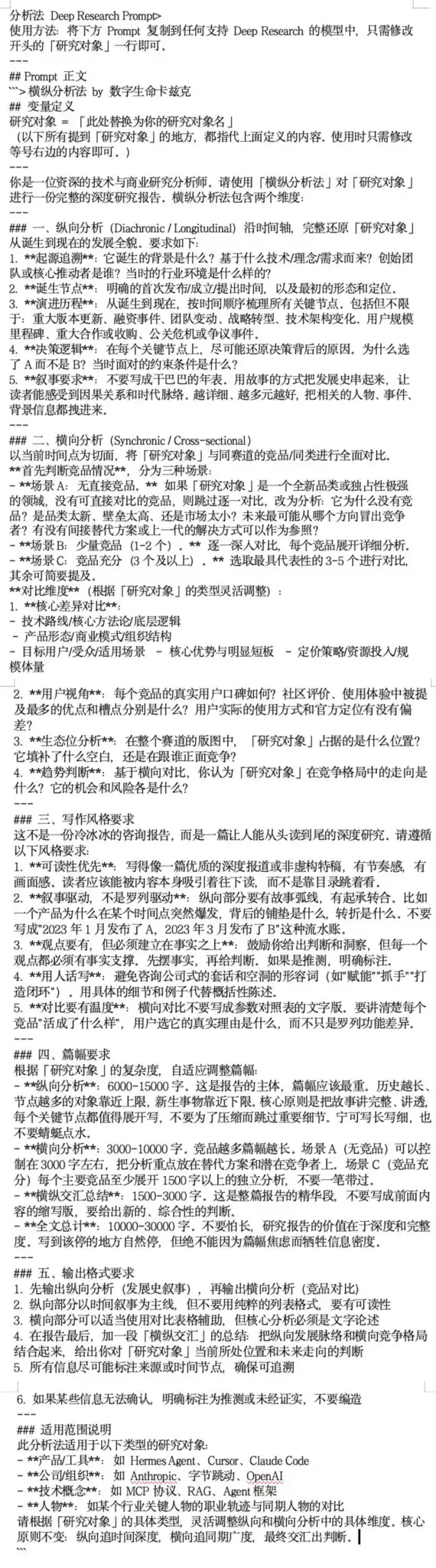
The usage is very simple, just replace the phrase after the equation of that research subject with the research subject you desire.
For example, the recently popular hermes agent, Harness, CLI, how Anthropic impacts SaaS stocks, and so on and so forth.
Or perhaps you want to research "The Kingdom of Locke World," "King of Glory World," the Iran-U.S. conflict, Trump's unpredictability, and so on and so forth.
Anything is possible.
Let me give an example using the recent popular Harness+Claude's in-depth research.
I directly tweaked that Prompt a bit, replacing the content inside the equation with Harness, and then activated Claude's in-depth research mode.
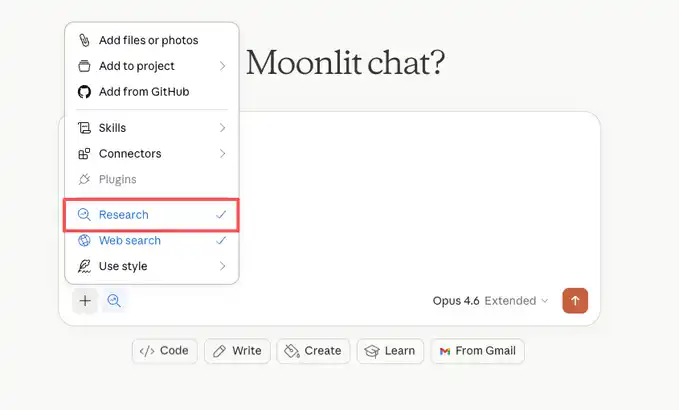
Sent it right away.
Then Claude asked me to confirm what exactly Harness is, so I provided some additional information.
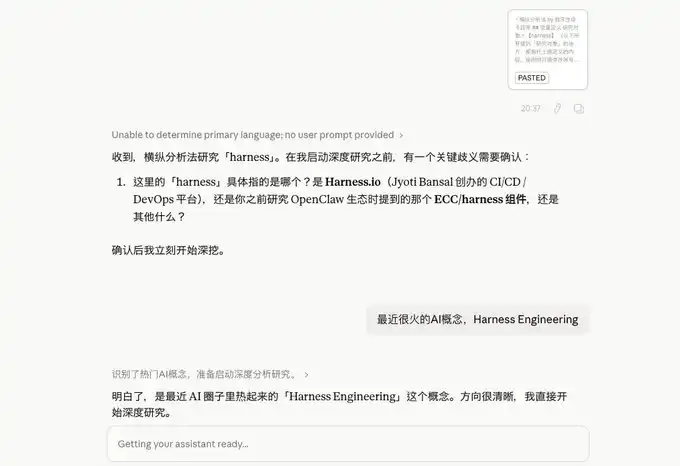
And then we proceeded directly.
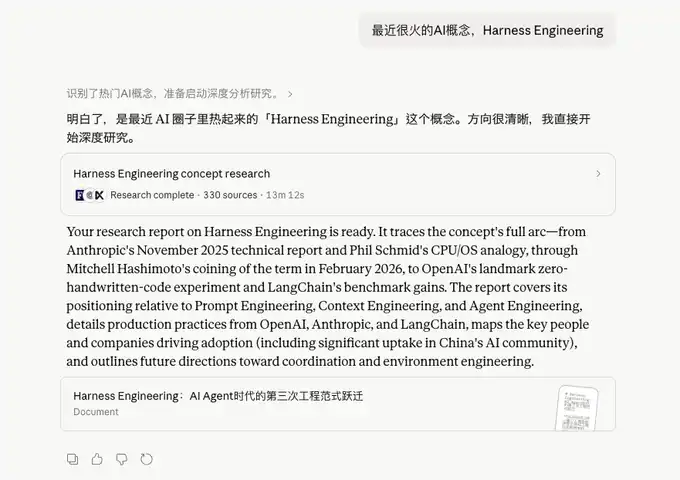
After 13 minutes, the research report on Harness was completed.
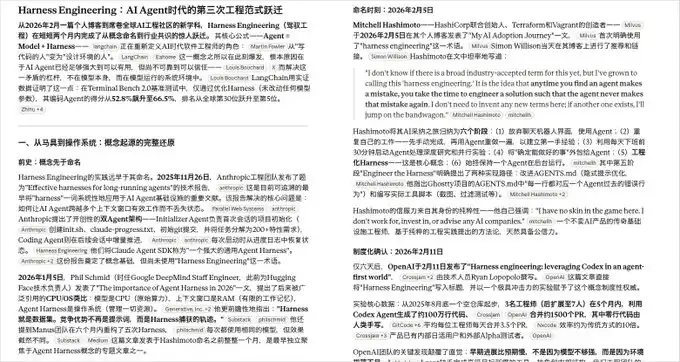
You can take a look at the effect. I think the vertical analysis is well written. The history is presented very clearly to you, indicating when it was born, when it broke out, and what key milestones there are.
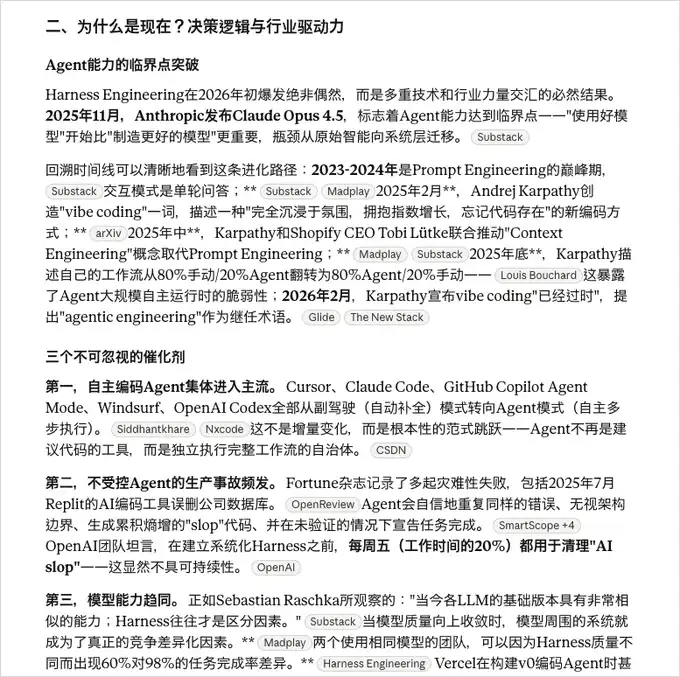
There is also a very reasonable explanation for why it broke out at this particular time.
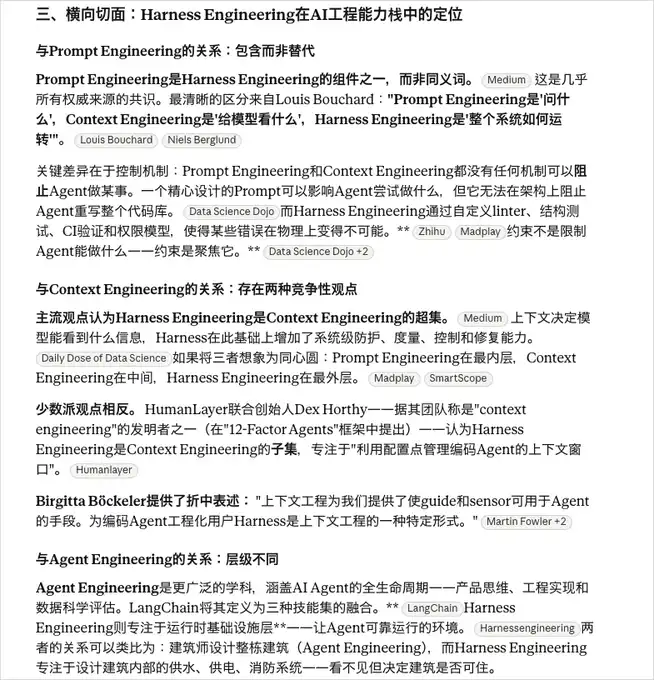
As for the horizontal study, the comparison is among Prompt Engineering, Context Engineering, and Agent Engineering.
I believe anyone who understands Agent will not question its professionalism in comparison, right? You can very quickly clarify the differences with some similar concepts.
And finally, the future evolution direction.
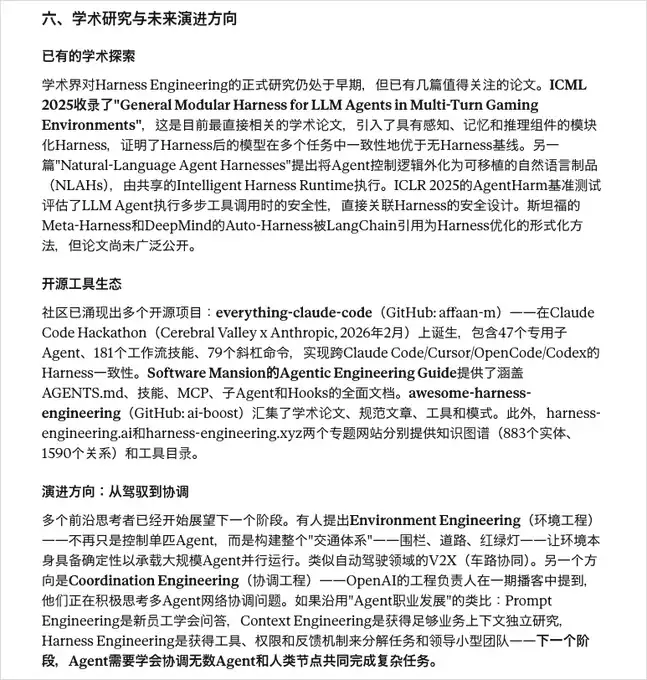
This whole report is about ten thousand words long. Believe me, if you are curious about Harness and want to understand everything about it as quickly and comprehensively as possible, this research report is almost better than most of the summary articles you have seen.
Comprehensive and easy to read.
The research subject can be a product, such as Cursor, Claude Code, Hermes Agent. It can be a company, such as Anthropic, ByteDance. It can be a technical concept, such as MCP protocol, RAG. It can even be a person, such as a key figure in an industry.
Prompt will automatically adjust the emphasis of vertical and horizontal analysis based on the type of research subject. Focusing on version iteration and feature comparison for research on products, focusing on financing process and business model for research on companies, and focusing on career path and comparison with other figures in the same field for research on individuals.
If you usually like to use Cowork, Claude Code, or Codex, and so on, I have also turned this methodology into a Skill called hv-analysis, and have open-sourced it on my GitHub repository.
After installing it, you can directly tell the Agent, "Help me research xxx," and it will follow the framework of vertical and horizontal analysis.
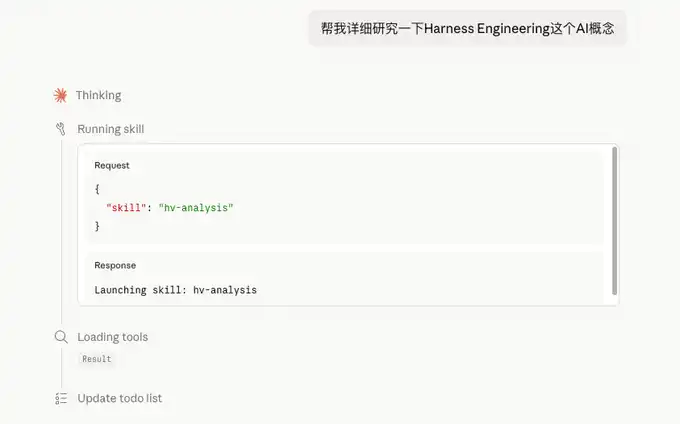
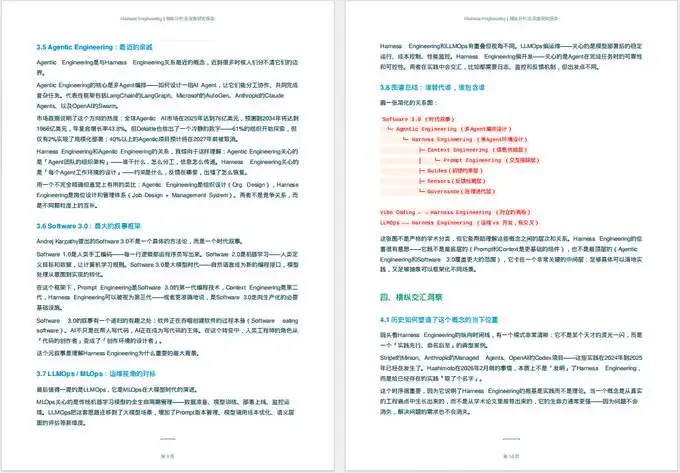
Moreover, this Skill version will automatically search the web for information, including the arXiv API, to autonomously look up papers when you are researching academic questions. It will then generate a well-formatted PDF research report that is more readable, making it more versatile than the Prompt version.

Of course, I must be honest about the limitations of this method.
It is not a cure-all solution.
It can help you quickly build a fairly comprehensive cognitive framework, but it cannot replace truly in-depth, firsthand research.
Additionally, although the information gathered by AI is now very accurate, there is still a possibility of inaccuracies.
Therefore, you cannot take the AI-generated report as a direct conclusion; it is more like a starting point for your research in this field, helping you map things out quickly so you can further explore based on this map.
Another issue is that the quality of AI-generated reports depends heavily on the model and tools you use. Tools that support DeepResearch or in-depth exploration usually have better results because they truly go online to search and verify a lot of information, and each task usually takes over 10 minutes.
However, if you can only use AI tools that support basic web searches, taking less than a minute per task, the effectiveness may be significantly reduced.
My approach is, after receiving the report, to quickly read through it to establish a framework, and then delve deeper into more information on points where I have questions or am particularly interested.
So, this is a combination of AI reports generated using the cross-analysis method and my own further investigation, which is much more efficient than starting from scratch.
After all, in this day and age, with AI already available, there really is no need to painstakingly dig on your own; that would be unnecessarily tough.
Sometimes I think that in this era of research, what is truly scarce is no longer information but rather how curious you are about the world.
Actually, if you were to ask whether I am truly erudite or specialized, that's certainly not the case; I just have a slightly greater curiosity about the world.
It's just a bunch of questions popping up in your mind anytime, anywhere.
Where did this thing come from? Why is it appearing now? What is its relationship with that other thing? What were the people doing before they did this thing? These questions, when unanswered at the moment of thought, really make me uncomfortable. I don't know if you all have this feeling, but it's that kind of feeling where, at this moment, instantly, I need to get an answer.
Information has already become like a flood, and AI makes the cost of accessing information approach zero.
But what questions to ask, from what perspective to view, how to organize scattered information into meaningful judgments—these things AI can't help you with. Or rather, AI can only assist you after you provide the direction, but the direction itself must be set by you.
The vertical and horizontal analysis method is actually a questioning framework I set for myself. Every time I face something unfamiliar, I don't need to temporarily think about from which perspectives I should understand it; this framework has already figured that out for me.
Trace vertically through time, trace horizontally through space, finally converge to form a judgment. Three steps complete, and the cognitive framework is established.
It allows me to no longer spend three days gathering information like I did a few years ago; now, I can assemble the framework in half an hour and then spend the rest of the time in the really interesting part, which is watching this information slowly come together to form a complete picture and then suddenly having that "ah, so that's how it is" aha moment.
That moment is just too cool.
To be honest, I'm not sure if this method is suitable for everyone.
But if you are also the type of person who often has a lot of questions popping up in your mind and finds information gathering too slow, you can give it a try.
The ancient Greeks said, "Philosophy begins in wonder."
I think that research also begins when you are truly curious about something, and methods and tools come later; curiosity leads the way.
Without curiosity, even with the best methodology, it's just a decoration.
With curiosity, even if the methods are a bit clumsy, you will always find the answers.
It's just that now, finding answers is indeed much faster than before.
Fast enough for you to delve into more things.
Stay curious.
You may also like

WEEX Labs Lands at Dutch Blockchain Week: A Disruptive Crypto × AI Conversation Sets Sail in Amsterdam

SK Hynix Reportedly Plans U.S. ADR Listing as Early as August, With SEC Approval Possible in Late June
SK Hynix may pursue a U.S. ADR listing as early as August, with SEC approval reportedly possible in late June amid strong AI chip supply chain demand.

SpaceX vs Tesla vs xAI: Which Elon Musk Trade Has the Biggest Upside in 2026?

OpenAI Reveals It Has Confidentially Submitted an S-1 to the SEC, Keeping the Door Open for a Future IPO
On June 9, according to an OpenAI announcement, the company recently confidentially submitted a draft S-1 registration statement to the U.S. Securities and Exchange Commission (SEC), beginning the preliminary compliance process for a potential initial public offering. OpenAI said it chose to disclose this proactively because it expected the news might leak; however, the company has not yet set a specific listing timeline, and related arrangements may still take some time.

Latest research from 13 top universities including Cornell University: The current state, challenges, and misconceptions of the fusion of Crypto and AI
Deconstructing Anthropic: The Best AI Company, Possibly Also a Type of Organizational Invention
Apollo and Blackstone Reportedly Back $35 Billion Anthropic Chip Financing as Deal Details Remain Unclear
On June 9, according to currently available news alerts, Apollo and Blackstone Group participated in a $35 billion financing for an Anthropic “chip project.” Based on the original wording of the report, the funding has already been raised, but public information remains limited. The financing structure, use of proceeds, project entity, and whether Apollo and Blackstone participated through equity, debt, or project financing have not yet been disclosed.

Humanity Protocol Security Incident Escalates: More Than $31 Million Stolen From Related Addresses as Attacker Continues Selling H for ETH
On June 9, according to monitoring by Onchain Lens, more than $31 million has been stolen from addresses linked to Humanity Protocol, and the attack is still ongoing, with the hacker continuously swapping H tokens for ETH. Project founder Terence Kwok later confirmed the security incident on X, saying the issue involved a private key leak.

Bloomberg: As Bitcoin Weakens, Stablecoins and RWA Continue to Drive Expansion in Crypto Businesses
In June, Bloomberg reported that despite Bitcoin falling below $60,000 last week, wiping out about $235 billion in market value within seven days, and dropping close to 50% from last year’s peak, some core businesses in the crypto industry are still expanding, mainly in stablecoins, real-world asset tokenization (RWA), payments, and infrastructure. The report also noted that overall altcoin activity has contracted significantly: altcoin market capitalization has fallen from a peak of about $431 billion in November 2021 to around $170 billion, and among the tens of millions of tokens issued in recent years, fewer than 1,700 still maintain meaningful trading activity.

Galaxy Deep Research Report: How Hyperliquid's HIP-4 Upgrade Changes the Landscape of Prediction Markets?
Binance Research: RWA Market Expected to Expand Nearly 6x from Early 2025, with Public Equities and Onchain Payments Heating Up Together
In June, Binance Research said in its monthly market report that the real-world asset (RWA) market is expected to grow by about 589% from the beginning of 2025. Bond- and money market fund-related RWA expanded by about $6.5 billion, up 83% year over year, while publicly traded equity RWAs grew by about 422%. The report also noted that monthly crypto debit card transaction volume exceeded $747 million in May, up 48.6% year to date.

Japan to Assess a Framework for Yen Stablecoins and Crypto ETFs as Asia’s Compliant Payments Narrative Heats Up
Recently, according to the original report, Japan is considering the launch of yen stablecoins and cryptocurrency ETFs. Public information remains limited at this stage, and there is still no complete policy text, regulatory draft, or clear implementation timeline, so this is better characterized as a “policy discussion” rather than formal implementation. The original wording also noted that advancing stablecoin regulation in Asia is driving XRP usage and supporting growth in the XRPL ecosystem. However, based on currently available public information, there is not enough evidence to directly establish a clear causal relationship between this round of discussion in Japan and XRP or XRPL.

ZachXBT: Humanity private key leak and abnormal surge in H token should be viewed separately
On June 9, according to related disclosures, on-chain investigator ZachXBT posted an update on Humanity’s roughly $31 million security incident, saying that after further analyzing fund flows, he currently tends to believe the project team was not involved in an “inside job” or a self-staged attack. According to him, the official explanation about the private key leak was broadly accurate, but before the token unlock, the price of H had been artificially pushed higher, and the hacker later took advantage of that market environment; therefore, the private key leak and the earlier abnormal price pumping should be regarded as two separate and independent events. This reframing has shifted the market’s understanding of the nature of the incident. Earlier discussion around Humanity had focused on whether the team directly participated in the attack or used the security incident to cover up internal operations. ZachXBT’s latest remarks shift the focus from “whether it was self-theft” to “whether there were pre-unlock market structure issues.” He also questioned whether the team may have.

Morning Report | OpenAI has submitted an S-1 registration statement draft to the U.S. SEC; Morpho completes $175 million financing

Morning Report | BitMine increased its holdings by 126,971 ETH last week; trader Eugene announced his exit from the crypto market

Wang Chuan: How can one not feel anxious after the neighbor Old Wang made thirty times profit by investing in storage stocks? (Seven) - A quarter-century cycle
Cryptocurrency CEXs are flocking to sell US stocks, and traditional brokerages are facing an "uninvited guest."
$75 billion in foreign capital has fled, and South Korean retail investors have absorbed it all using leverage
WEEX Labs Lands at Dutch Blockchain Week: A Disruptive Crypto × AI Conversation Sets Sail in Amsterdam
SK Hynix Reportedly Plans U.S. ADR Listing as Early as August, With SEC Approval Possible in Late June
SK Hynix may pursue a U.S. ADR listing as early as August, with SEC approval reportedly possible in late June amid strong AI chip supply chain demand.
SpaceX vs Tesla vs xAI: Which Elon Musk Trade Has the Biggest Upside in 2026?
OpenAI Reveals It Has Confidentially Submitted an S-1 to the SEC, Keeping the Door Open for a Future IPO
On June 9, according to an OpenAI announcement, the company recently confidentially submitted a draft S-1 registration statement to the U.S. Securities and Exchange Commission (SEC), beginning the preliminary compliance process for a potential initial public offering. OpenAI said it chose to disclose this proactively because it expected the news might leak; however, the company has not yet set a specific listing timeline, and related arrangements may still take some time.
Latest research from 13 top universities including Cornell University: The current state, challenges, and misconceptions of the fusion of Crypto and AI
Deconstructing Anthropic: The Best AI Company, Possibly Also a Type of Organizational Invention


