
Stable is having its TGE tonight, will the market still buy into the stablecoin public blockchain narrative?


Original Article Title: "Stable Tonight TGE, Does the Stablecoin Public Chain Narrative Market Still Buy It?"
Original Article Author: 1912212.eth, Foresight News
At 21:00 on December 8th Beijing time, the Stable mainnet will be officially launched. Stable, as a Layer 1 blockchain supported by Bitfinex and Tether, focuses on stablecoin infrastructure. Its core design aims to use USDT as the native gas fee to achieve sub-second settlement and gas-free peer-to-peer transfers. As of the time of writing, exchanges including Bitget, Backpack, and Bybit have announced the listing of STABLE spot trading. In addition, Binance, Coinbase, and Korean exchanges have not yet announced the listing of STABLE spot trading.
Total Supply of 1 Trillion, Tokens Not Used as Gas Fees
Prior to the mainnet launch, the project team has released the whitepaper and tokenomics details. The native token of the project, STABLE, has a total supply of 1 trillion tokens, with the total amount fixed. Stable network transfers, payments, and transactions are settled in USDT, and STABLE is not used as a gas fee but is used for coordinating incentive mechanisms between developers and ecosystem participants. The STABLE token distribution is as follows: Genesis Distribution accounts for 10% of the total supply, supporting initial liquidity, community activation, ecosystem activities, and strategic distribution work; the Genesis Distribution portion will be fully unlocked at the launch of the mainnet.
40% of the total supply is allocated to the ecosystem and community, distributed to developer grants, liquidity programs, partnerships, community initiatives, and ecosystem development; 25% is allocated to the team, including the founding team, engineers, researchers, and contributors; and 25% is allocated to investors and advisors, supporting strategic investors and advisors for network development, infrastructure construction, and promotion.
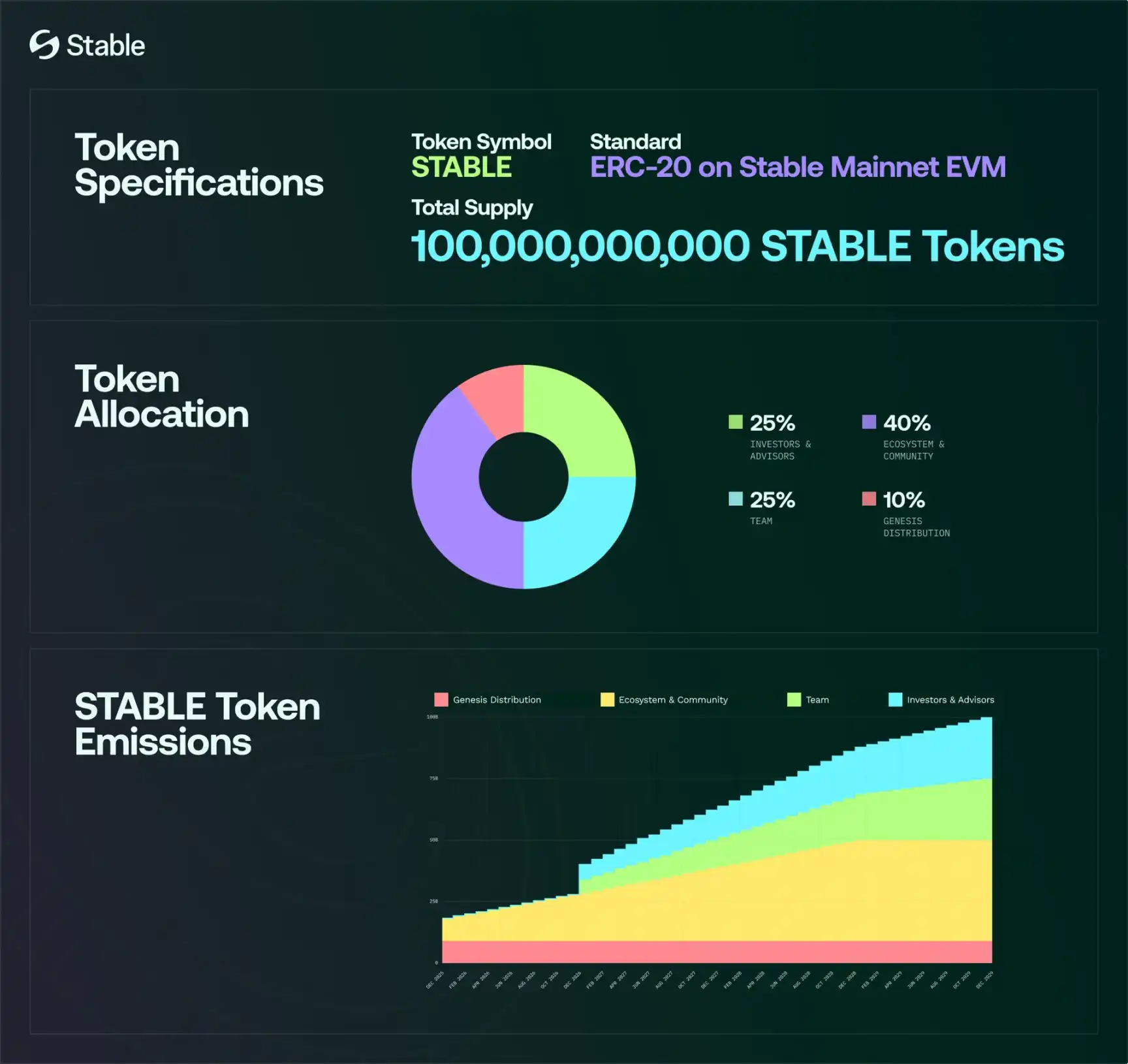
Both the team and investor shares have a one-year cliff period, with zero unlock in the first 12 months, followed by linear release. The ecosystem and community fund share unlocks 8% at launch, with the remaining portion gradually released through linear vesting to incentivize developers, partners, and user growth.
Stable adopts the StableBFT consensus protocol and utilizes a DPoS (Delegated Proof of Stake) model. This design maintains the economic security properties required for a global payment network while supporting high-throughput settlement. Staking the STABLE token is the mechanism for validators and delegators to participate in consensus and earn rewards. The STABLE token's main roles are governance and staking: holders can stake their tokens to become validators, participate in network security maintenance, and influence protocol upgrades through DAO voting, such as adjusting fee rates or introducing support for new stablecoins.
In addition, STABLE can be used for ecosystem incentives, such as liquidity mining or cross-chain bridging rewards. The project team claims that this separation design can attract institutional funds because USDT's stability is much higher than that of volatile governance tokens.
Pre-Deposit Controversy: Insider Trading, KYC Bottleneck
Similar to Plasma, Stable also opened deposits twice before the mainnet launch. The first-phase pre-deposit started at the end of October with a cap of $825 million but was filled within minutes after the announcement. The community questioned some players' insider trading. The top-ranked wallet deposited hundreds of millions of USDT 23 minutes before open deposits.
The project team did not directly respond and opened the second phase of pre-deposit activities on November 6 with a cap of $500 million.
However, Stable underestimated the market's enthusiasm for deposits. At the moment the second phase opened, a massive influx of traffic caused the website to slow down and bottleneck. As a result, after updating the rules, Stable allowed users to deposit through the Hourglass frontend or directly on-chain; the deposit feature reopened for 24 hours, with each wallet able to deposit up to $1 million, with the minimum deposit amount remaining at $1,000.
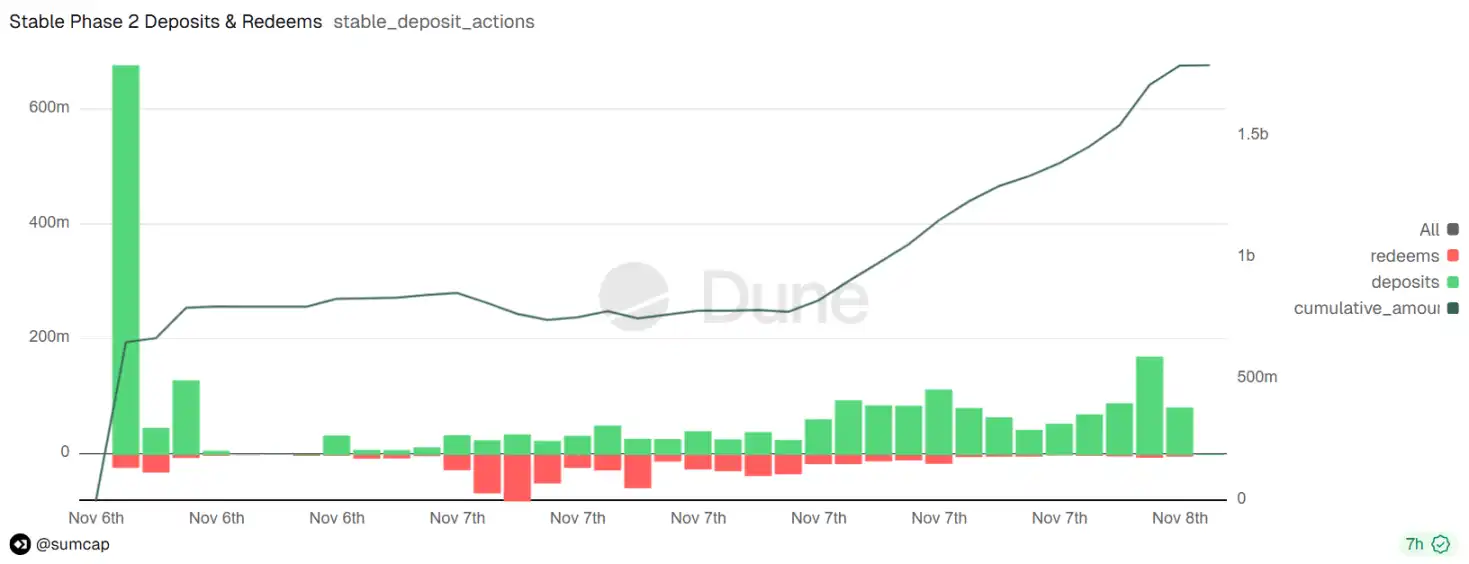
Ultimately, the total deposits in the second phase were approximately $1.8 billion, with around 26,000 participating wallets.
The audit time varied from a few days to a week, with some community users complaining about system bottlenecks or repeated requests for additional documentation.
$20 Billion FDV Probability Over 85%
At the end of July this year, Stable announced the completion of a $28 million seed round of financing, led by Bitfinex and Hack VC, bringing its market valuation to around $3 billion.
By comparison, Plasma's market value is now $3.3 billion, with an FDV of $16.75 billion.
Some optimistic observers believe that the stablecoin narrative, Bitfinex's endorsement, and Plasma's rise and fall may indicate that there will still be some heat and upward price momentum in the near future. However, pessimistic voices are stronger: Gas fees not payable with STABLE, limited utility, especially as the market has entered a bear market cycle where liquidity has become tight, its price may drop rapidly.
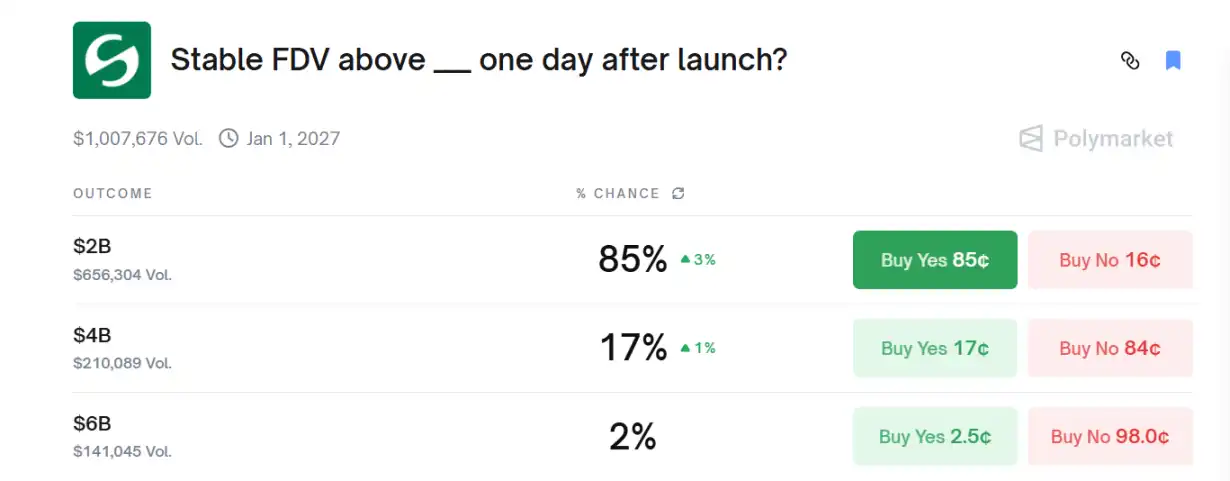
Currently, Polymarket data shows that the probability of FDV exceeding $20 billion after its listing day is 85%. Based on a conservative $20 billion calculation, the STABLE price would correspond to $0.02.
In terms of perpetual contract market, according to Bitget data, the STABLE/USDT is currently priced at $0.032, with its estimated FDV expected to rise to around $3 billion.
The first phase of Stable's pre-deposit reached $825 million, with the actual contribution of the second phase exceeding $1.1 billion, but after proportional distribution, the actual amount entered the pool was $500 million. The total pre-deposit scale is $1.325 billion. The tokenomics disclosed an initial allocation of 10% (used for pre-deposit activity incentives, exchange platform activities, initial on-chain liquidity, etc.). Assuming Stable eventually airdrops a share of 3% to 7% to pre-deposits, calculated based on the pre-market price of $0.032, the corresponding return is approximately 7% to 16.9%. This means that for every $10,000 deposit, the corresponding earnings are $700 to $1,690.
You may also like

Mastercard Launches Agent Pay for AI, Plans to Record AI Agent Payment Authorizations on Polygon
Mastercard launched Agent Pay for AI, a new payment protocol designed to help AI agents make small payments such as pay-per-use access to data and APIs. The system plans to record human-granted AI agent permissions on Polygon, focusing on verifiable authorization, identity, and payment controls.

Curve Deploys Llamalend v2 on Optimism With 250,000 OP Incentives
Curve launched Llamalend v2 on Optimism with 250,000 OP incentives from the Optimism Foundation. The upgrade expands Llamalend beyond its earlier crvUSD-focused model, adding broader collateral support, LlamaRisk market reviews, and the ability to use Curve LP tokens as collateral.

Raydium Old Liquidity Pool Reportedly Exploited, With $1.34 Million Moved to Ethereum and Tornado Cash
An old Raydium liquidity pool was reportedly exploited for around $1.34 million in USDC, RAY, and wSOL, with the stolen funds bridged to Ethereum and deposited into Tornado Cash. The incident highlights the tail risks of legacy DeFi pools, old contracts, and cross-chain fund laundering paths.

Kalshi Executive Challenges “SBF Backed AI Unicorns” Narrative, Says Leopold Aschenbrenner Was Key Figure
Kalshi executive John Wang questioned the “SBF backed AI unicorns” narrative, saying Leopold Aschenbrenner was the key figure behind major AI investment decisions.

Pantera Capital Partner: How Tokenization is Restructuring the Private Equity and Early Investment Ecosystem?

New York Proposes Stricter Stablecoin Issuer Rules Aligned With Federal GENIUS Act
NYDFS proposed stricter stablecoin issuer rules aligned with the GENIUS Act, covering reserves, custody, redemption timelines, audits, and capital buffers.
Every exchange is a "Universal Exchange."

The counterattack of traditional finance: Alliance chains are quietly reviving

CryptoQuant Says Bitcoin Profitable Supply Is Near 45% Pressure Zone as On-Chain Data Points to Market Repricing
CryptoQuant said Bitcoin’s profitable supply is nearing the 45% pressure zone, signaling rising market stress, unrealized losses, and a possible on-chain repricing phase.

Bitcoin Falls Below 200-Week Moving Average as On-Chain Data Shows Over Half of Supply in Loss
Bitcoin dropped below its 200-week moving average as on-chain data showed over 50% of circulating supply is now in loss, signaling rising market stress.

CFTC Reportedly Plans New Prediction Market Rules Focused on Manipulation Risk and Public Interest Review
The CFTC is reportedly preparing new prediction market rules focused on manipulation risk, public interest review, and retail trader protections.

Meet the new WEEX trial fund—your gateway to greater profits

WEEX Labs Lands at Dutch Blockchain Week: A Disruptive Crypto × AI Conversation Sets Sail in Amsterdam
SK Hynix Reportedly Plans U.S. ADR Listing as Early as August, With SEC Approval Possible in Late June
SK Hynix may pursue a U.S. ADR listing as early as August, with SEC approval reportedly possible in late June amid strong AI chip supply chain demand.

SpaceX vs Tesla vs xAI: Which Elon Musk Trade Has the Biggest Upside in 2026?
OpenAI Reveals It Has Confidentially Submitted an S-1 to the SEC, Keeping the Door Open for a Future IPO
On June 9, according to an OpenAI announcement, the company recently confidentially submitted a draft S-1 registration statement to the U.S. Securities and Exchange Commission (SEC), beginning the preliminary compliance process for a potential initial public offering. OpenAI said it chose to disclose this proactively because it expected the news might leak; however, the company has not yet set a specific listing timeline, and related arrangements may still take some time.
Latest research from 13 top universities including Cornell University: The current state, challenges, and misconceptions of the fusion of Crypto and AI
Deconstructing Anthropic: The Best AI Company, Possibly Also a Type of Organizational Invention
Mastercard Launches Agent Pay for AI, Plans to Record AI Agent Payment Authorizations on Polygon
Mastercard launched Agent Pay for AI, a new payment protocol designed to help AI agents make small payments such as pay-per-use access to data and APIs. The system plans to record human-granted AI agent permissions on Polygon, focusing on verifiable authorization, identity, and payment controls.
Curve Deploys Llamalend v2 on Optimism With 250,000 OP Incentives
Curve launched Llamalend v2 on Optimism with 250,000 OP incentives from the Optimism Foundation. The upgrade expands Llamalend beyond its earlier crvUSD-focused model, adding broader collateral support, LlamaRisk market reviews, and the ability to use Curve LP tokens as collateral.
Raydium Old Liquidity Pool Reportedly Exploited, With $1.34 Million Moved to Ethereum and Tornado Cash
An old Raydium liquidity pool was reportedly exploited for around $1.34 million in USDC, RAY, and wSOL, with the stolen funds bridged to Ethereum and deposited into Tornado Cash. The incident highlights the tail risks of legacy DeFi pools, old contracts, and cross-chain fund laundering paths.
Kalshi Executive Challenges “SBF Backed AI Unicorns” Narrative, Says Leopold Aschenbrenner Was Key Figure
Kalshi executive John Wang questioned the “SBF backed AI unicorns” narrative, saying Leopold Aschenbrenner was the key figure behind major AI investment decisions.
Pantera Capital Partner: How Tokenization is Restructuring the Private Equity and Early Investment Ecosystem?
New York Proposes Stricter Stablecoin Issuer Rules Aligned With Federal GENIUS Act
NYDFS proposed stricter stablecoin issuer rules aligned with the GENIUS Act, covering reserves, custody, redemption timelines, audits, and capital buffers.


