
Market Share Plummets by 60% - Can Hyperliquid Stage a Comeback with HIP-3 and Builder Codes?

Original Article Title: Hyperliquid Growth Situation
Original Article Author: @esprisi0
Translation: Peggy, BlockBeats
Editor's Note: Hyperliquid once dominated the decentralized derivatives track, but in the second half of 2025, its market share plummeted rapidly, sparking industry attention: has it peaked, or is it positioning for the next stage? This article reviews Hyperliquid's three stages: from the ultimate dominance with a market share soaring to 80%, to strategic transformation and accelerated competition leading to a loss of momentum down to 20%, and then to a re-emergence centered around HIP-3 and Builder Codes.
The following is the original text:
Over the past few weeks, concerns about the future of Hyperliquid have escalated. The loss of market share, rapidly rising competitors, and increasingly crowded derivatives track have raised a key question: what exactly is happening beneath the surface? Has Hyperliquid already peaked, or is the current narrative overlooking deeper structural signals?
This article will dissect it one by one.
Stage One: Ultimate Dominance
From early 2023 to mid-2025, Hyperliquid consistently hit historical highs in key metrics and steadily increased its market share, thanks to several structural advantages:
A points-based incentive mechanism that attracted a large amount of liquidity; a first-mover advantage in launching new perpetual contracts (such as $TRUMP, $BERA), making Hyperliquid the most liquid venue for new trading pairs and the preferred platform for pre-listing trading (such as $PUMP, $WLFI, XPL). To not miss out on emerging trends, traders were compelled to flock to Hyperliquid, driving its competitive edge to its peak; best UI/UX experience among all perpetual contract DEXs; lower fees compared to centralized exchanges (CEXs); introduction of spot trading, unlocking new use cases; Builder Codes, HIP-2, and HyperEVM integration; achieving zero downtime even during major market crashes.
As a result, Hyperliquid's market share grew continuously for over a year, reaching a peak of 80% in May 2025.
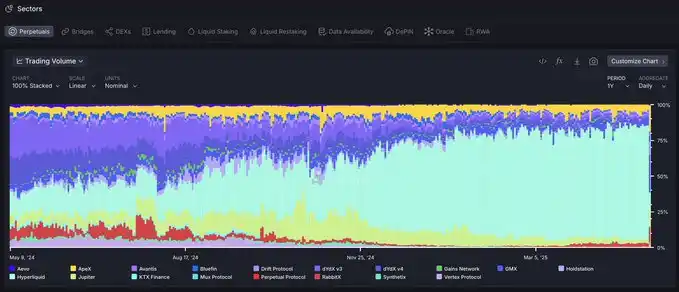
Perpetual Contract Trading Volume Market Share data provided by @artemis
At that stage, the Hyperliquid team was significantly ahead of the entire market in innovation and execution speed, with no truly comparable products in the entire ecosystem.
The Rise of Liquidity-as-a-Service in the Second Stage and Accelerated Competition
Since May 2025, Hyperliquid's market share has plummeted sharply, dropping from around 80% to close to 20% of the trading volume by early December.
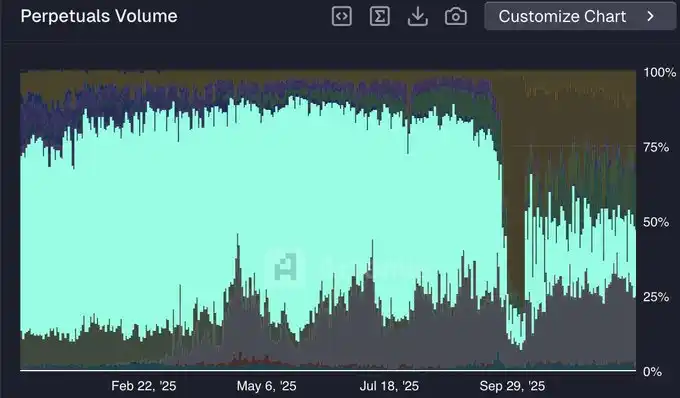
@HyperliquidX Market Share (Data Source: @artemis)
This relative loss of momentum against competitors can be attributed to several factors:
Strategic Shift from B2C to B2B
Hyperliquid did not double down on a pure B2C model, such as launching a proprietary mobile app or continually rolling out new perpetual contract products, but chose to pivot to a B2B strategy, positioning itself as the "AWS of Liquidity."
This strategy focused on building core infrastructure for external developers to use, such as Builder Codes for the front end and HIP-3 for launching new perpetual markets. However, this transformation essentially ceded the initiative for product deployment to third parties.
In the short term, this strategy did not perform ideally in attracting and retaining liquidity. The infrastructure was still in its early stages, adoption takes time, and external developers did not yet have the distribution capability and trust built up over the long term by the Hyperliquid core team.
Competitors Seizing the Opportunity of Hyperliquid's Transformation
Unlike Hyperliquid's new B2B model, competitors continued to maintain full vertical integration, allowing them to significantly accelerate their speed when launching new products.
Since they did not need to delegate execution, these platforms maintained full control over product releases while leveraging their established user trust to rapidly expand. As a result, they are more competitive than they were in the first stage.
This directly translates into market share growth. Competitors are now not only offering all products on Hyperliquid but also launching features on HL that have not yet gone live (such as Lighter launching spot markets, perpetual equities, and forex).
Incentives and "Hire-to-Liquidity"
Hyperliquid has gone over a year without running any official incentive programs, while its main competitors are still actively engaging. Lighter, currently leading in trading volume market share (about 25%), is still in its pre-TGE incentive season.
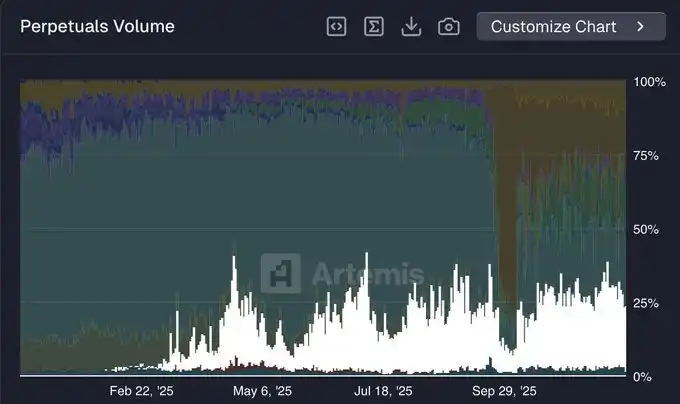
@Lighter_xyz Market Share (Source: @artemis)
In the DeFi space, liquidity is more “hire-to” than anywhere else. A significant portion of the volume flowing from Hyperliquid to Lighter (and other platforms) is likely incentive-driven, related to airdrop farming. Like most perpetual DEXs running incentive seasons, Lighter's market share is expected to decrease post-TGE.
Phase Three HIP-3 and the Rise of Builder Codes
As mentioned earlier, building the "AWS of liquidity" is not the short-term optimal strategy. However, in the long run, this model precisely positions Hyperliquid to potentially become the core hub of global finance.
While competitors have replicated most of Hyperliquid's current features, real innovation still stems from Hyperliquid. Developers building on Hyperliquid benefit from domain focus, allowing them to formulate more targeted product development strategies on an evolving infrastructure. On the other hand, protocols like Lighter that maintain complete vertical integration will face constraints when optimizing the development of multiple product lines simultaneously.
HIP-3 is still in its early stages, but its long-term impact has begun to materialize. Key participants include:
@tradexyz has launched perpetual equities
@hyenatrade recently deployed a trading terminal for USDe
More experimental markets are emerging, such as @ventuals offering pre-IPO exposure and @trovemarkets catering to niche speculative markets like Pokémon or CS:GO assets.
By 2026, it is expected that the HIP-3 market will capture a significant share of Hyperliquid's total trading volume.
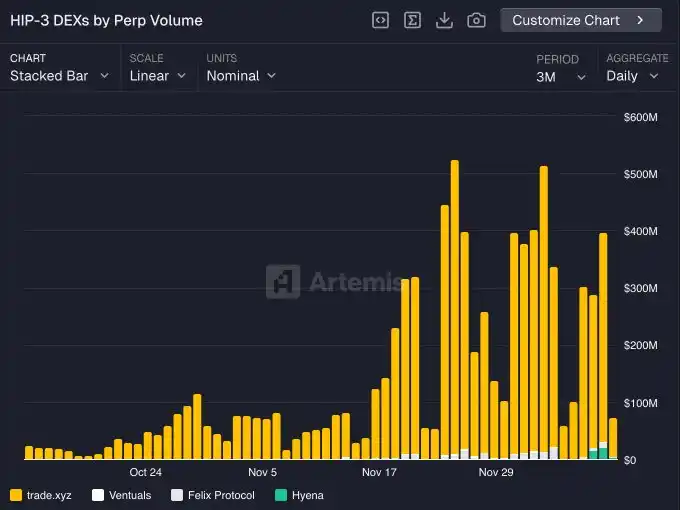
HIP-3 Trading Volume (by Builder)
The key driver behind the eventual restoration of Hyperliquid's dominance is the synergistic effect between HIP-3 and Builder Codes. Any frontend integrated with Hyperliquid can instantly access the full HIP-3 market, providing users with unique products.
Therefore, developers have a strong incentive to list on the HIP-3 market as these markets can be distributed on any compatible frontend (such as Phantom, MetaMask, etc.) and tap into entirely new sources of liquidity. It's a perfect virtuous cycle.
The ongoing development of Builder Codes makes me more optimistic about the future, whether in terms of revenue growth or active user expansion.
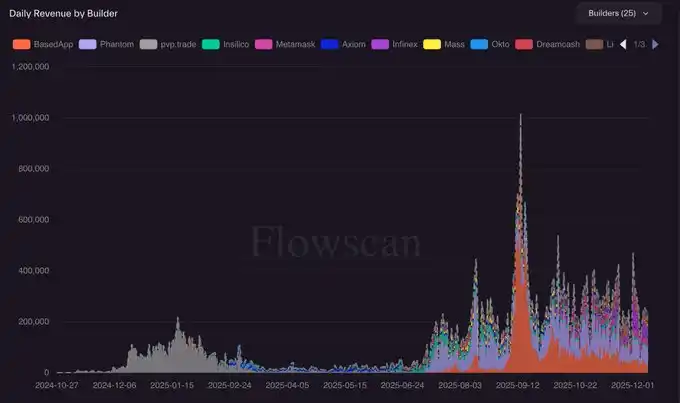
Builder Codes Revenue (data source: @hydromancerxyz)
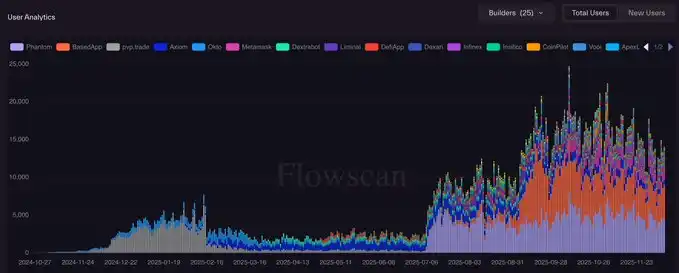
Builder Codes Daily Active Users (data source: @hydromancerxyz)
Currently, Builder Codes are primarily used by native crypto applications (such as Phantom, MetaMask, BasedApp, etc.). However, I anticipate a new class of super apps built on Hyperliquid to emerge in the future, aimed at attracting an entirely non-native crypto user base.
This is very likely to become the key path for Hyperliquid to enter the next stage of scaling, which will also be the focus of my next article.
You may also like

Bitcoin Trading Guide 2026: Strategies for Experienced Traders

What Is XAUT and PAXG? Why Tokenized Gold Is Booming in 2026

Cryptocurrency CEXs are flocking to sell US stocks, and traditional brokerages are facing an "uninvited guest."

Will the SpaceX IPO Hurt Bitcoin? Here's What Traders Are Watching
Foreign selling in the South Korean stock market accelerates, with cumulative net sales reportedly reaching $75 billion this year
On June 9, The Kobeissi Letter, citing Goldman Sachs data, reported that global investors are selling South Korean stocks at an unusually rapid pace. In the latest trading session, foreign investors sold about $801 million worth of Kospi constituent stocks again; total foreign outflows last week reached about $10 billion, and the market has been in net foreign selling on nearly every trading day over the past month. According to the data cited in the report, foreign investors have sold about $75 billion worth of South Korean stocks so far this year. Meanwhile, South Korean retail and institutional investors together recorded roughly $69 billion in net buying over the same period, suggesting that the market’s main buying support has come from domestic capital rather than returning overseas funds. The information currently disclosed still mainly comes from The Kobeissi Letter’s retelling and Goldman Sachs data summaries, while public details on the statistical period and the specific definition of “selling” remain relatively limited.

Fortune Warns of Strategy’s Financing Structure Risks as Bitcoin Premium Narrows
Fortune warned that Strategy’s Bitcoin treasury model faces growing financing risks as MSTR’s net asset premium narrows and preferred stock dividend pressure increases.

Ferrari Challenge Le Mans: Carl Moon to Dominate in WEEX Livery

Sahara AI Responds to SAHARA’s Sharp Drop: No Contract or Product Security Issues Found, Internal Investigation Underway
Sahara AI responded to SAHARA’s 60% price drop, saying no token contract or product security issues have been found and an internal investigation is underway.

WEEX Deposit/Withdrawal Dynamic Island: Your Asset Status, Always in Sight

Scaling Crypto Derivatives: The Digital Asset Infrastructure Behind High-Volume Trading
In the fast-moving digital asset ecosystem, derivatives platforms face an extreme architectural test. High-leverage futures markets demand more than just standard security—they require absolute operational precision, zero-latency matching engines, and ironclad structural scalability, all while navigating intense market volatility.
As global platforms scale to meet these demands, the industry is shifting away from rigid, monolithic setups toward a more agile, "decoupled" infrastructure philosophy.
The Blueprint for High-Volume Copy TradingFor elite global exchanges like WEEX (founded in 2018), this architectural choice becomes critical when scaling high-volume retail features like social copy trading. When thousands of users automatically mirror the real-time strategies of elite traders simultaneously, it triggers sudden, monumental spikes in concurrent transactional volume.
To prevent execution latency or settlement bottlenecks during these peak volatility events, a platform's primary engine must remain entirely dedicated to risk management, copy-trade synchronization, and order matching.
The Architectural Rule: New-generation platforms must separate front-end user execution engines from heavy backend infrastructural overhead to eliminate operational friction.
By separating these layers, platforms can maintain complete sovereignty over their trading environments and user experiences while strategically aligning with institutional-grade infrastructure ecosystems. This strategic framework allows modern exchanges to leverage advanced Digital Asset Custody infrastructure such as Cobo’s behind the scenes, ensuring that backend wallet management scales elastically alongside trading spikes.
Capitalizing on Market Momentum and 400× LeverageIn a derivatives arena where platforms offer up to 400× leverage on perpetual contracts, capital efficiency and market agility are core business metrics. To capture market momentum, an exchange needs the ability to rapidly expand its asset offerings, supporting everything from legacy crypto assets to sudden, trending altcoins across a massive library of trading pairs.
Adopting a flexible, scalable Wallet-as-a-Service (WaaS) solution such as Cobo’s could completely rewrite the development timeline for high-growth exchanges. Instead of spending months of engineering capital building out custom backend wallet architectures for every new blockchain network, platforms can deploy localized infrastructure in days.
This agility allows platforms to instantly scale their listings to over a thousand trading pairs without compromising security or delaying time-to-market. It mirrors the exact operational advantages seen during high-velocity market events, similar to how advanced wallet infrastructure empowers platforms during sudden asset surges; allowing exchanges to pass that speed and liquidity directly to their global user base.
A Mature Foundation for GrowthThe synergy between trusted infrastructure ecosystems and global trading platforms represents the natural evolution of a maturing crypto market. As WEEX continues to scale its global spot and derivatives offerings for over 6 million users, adopting robust backend paradigms proves that platforms no longer have to compromise between cutting-edge trading velocity and uncompromised structural security.

Morning Report | BitMine increased its holdings by 126,971 ETH last week; trader Eugene announced his exit from the crypto market

Wang Chuan: How can one not feel anxious after the neighbor Old Wang made thirty times profit by investing in storage stocks? (Seven) - A quarter-century cycle

Get Paid to Onboard? Try WEEX’s New Homepage with Rewards for Registration, Deposit & Trade

WEEX Custom Layout: Build Your Perfect Trading Workspace in Seconds

See “Buy Walls” & “Sell Walls” Instantly: WEEX Launches the Depth Chart for Smarter Trades

What Is Quick Trade on WEEX? 2 Ways WEEX Ends Chart-Panel Jumping
Morning News | Five major virtual asset platforms in South Korea have experienced 57 incidents of hacking and system failures in six years; Grayscale submits registration application for Canton ETF
Should we escape the peak? The principle of the tail-end market in the stock market
Bitcoin Trading Guide 2026: Strategies for Experienced Traders
What Is XAUT and PAXG? Why Tokenized Gold Is Booming in 2026
Cryptocurrency CEXs are flocking to sell US stocks, and traditional brokerages are facing an "uninvited guest."
Will the SpaceX IPO Hurt Bitcoin? Here's What Traders Are Watching
Foreign selling in the South Korean stock market accelerates, with cumulative net sales reportedly reaching $75 billion this year
On June 9, The Kobeissi Letter, citing Goldman Sachs data, reported that global investors are selling South Korean stocks at an unusually rapid pace. In the latest trading session, foreign investors sold about $801 million worth of Kospi constituent stocks again; total foreign outflows last week reached about $10 billion, and the market has been in net foreign selling on nearly every trading day over the past month. According to the data cited in the report, foreign investors have sold about $75 billion worth of South Korean stocks so far this year. Meanwhile, South Korean retail and institutional investors together recorded roughly $69 billion in net buying over the same period, suggesting that the market’s main buying support has come from domestic capital rather than returning overseas funds. The information currently disclosed still mainly comes from The Kobeissi Letter’s retelling and Goldman Sachs data summaries, while public details on the statistical period and the specific definition of “selling” remain relatively limited.
Fortune Warns of Strategy’s Financing Structure Risks as Bitcoin Premium Narrows
Fortune warned that Strategy’s Bitcoin treasury model faces growing financing risks as MSTR’s net asset premium narrows and preferred stock dividend pressure increases.

Popular coins
Latest Crypto News


